This week an Iranian general called for a unique way to bypass the sanctions on his country enforced by the United States.
Saeed Muhammad, commander of the Islamic Revolutionary Guard Corps, called for Iran to use cryptocurrencies to evade the economic sanctions. According to the Telegram channel of Coinit.ir, a crypto news organization based in Iran, the general addressed a crowd on Feb. 26 (translated from Farsi):
“We are demanding the creation of a more sophisticated mechanism to bypass sanctions. To circumvent sanctions, we must develop solutions such as the exchange of products and the use of cryptocurrencies with our partnerships [in other countries].”
The people of Iran have seen the value of their currency drop significantly in the wake of the sanctions imposed by the Trump administration, following the withdrawal of the US from the Joint Comprehensive Plan of Action in 2018.
Sanctions have effectively isolated Iran from foreign trade and investment and the use of cryptocurrencies has been on the rise ever since as a way to circumvent them. Bitcoin has been described in interviews as one of the only ways to get money in and out of the country.
Iranian President Hassan Rouhani’s administration announced it would launch a national cryptocurrency back in 2018. More recently, Iran’s Ministry of Industries, Mining and Trade issued more than 1,000 cryptocurrency mining licenses to domestic operations.
Earler this week the intergovernmental Financial Action Task Force added Iran to a blacklist of countries not complying with anti-terrorism financing requirements.
Confidential Transactions keep the amount and type of assets transferred visible only to participants in the transaction (and those they choose to reveal the blinding key to), while still cryptographically guaranteeing that no more coins can be spent than are available.
This goes a step beyond the usual privacy offered by Bitcoin’s blockchain, which relies purely on pseudonymous (but public) identities. This matters, because insufficient financial privacy can have serious security and privacy implications for both commercial and personal transactions. Without adequate protection, thieves can focus their efforts on high-value targets, competitors can learn business details, and negotiating positions can be undermined.
Confidential Transactions (CTs, the general idea of which was proposed by Adam Back on BitcoinTalk in 2013) aims to make the content of a transaction private — as Greg Maxwell explains in a 2017 talk, the amounts transacted are often more valuable to spies: if you wanted to spend 500 sats on a coffee but broke up a 1 BTC UTXO to do so, the barista would now know that you owned at least 0.999995 BTC (which could be problematic for your security if coins hit new highs in dollar value).
With CTs, both the receiver’s address and the amount transferred are hidden from any observers, in such a way that only parties to the transaction (and those they share it with) are aware of the value sent/received. For this to work, a cryptographic technique known as a Pedersen commitment is used.
I’m not a cryptographer, and it would be a waste of everyone’s time for me to try to explain how they work. I’d recommend this outstanding primer by ecurrencyhodler, or Maxwell’s initial investigation. Suffice it to say, a Pedersen commitment functions similarly to a regular commitment scheme, but allows for some mathematical manipulation that enables the verification of data without it being divulged.
Why is this important? Remember that, in order to work, the Bitcoin ledger needs to be balanced (inputs need to match outputs). That’s straightforward enough when every transaction is made public and nodes can verify it. Given that the purpose of Confidential Transactions is to redact amounts from the blockchain, however, a more creative approach is needed (the Pedersen commitments, paired with a few other tools) to ensure no one’s playing central bank and secretly printing off more money.
Justin Sun, the founder and CEO of Tron (TRX), the 15th biggest cryptocurrency by market cap, is investing in a number of cryptos other than Bitcoin (BTC).
In a Feb. 23 interview with CNN, Tron CEO said that he is a long-term believer in cryptocurrencies and owns a stake in many altcoins, including the two largest coins after Bitcoin — Ether (ETH) and XRP.
When asked whether Sun has its crypto portfolio diversified, the Tron CEO answered:
“I own a lot of XRP and Ethereum, too. I’m like a long-term believer of the crypto so I want all crypto assets to succeed. So that’s why I own a lot of other different cryptos as well.”
As a major believer in crypto, Sun is bullish on the price of cryptocurrencies and confident that cryptos like Bitcoin are the future of money. In the interview, Tron CEO predicted that Bitcoin will cross $100,000 mark in 2025, emphasizing that other cryptocurrencies will follow the trend.
Justin Sun’s $100,000 Bitcoin prediction in his own words:
“I definitely believe Bitcoin will pass $100K in 2025. I believe we can achieve this price before 2025. At the same time, I think a lot of other crypto projects like Tron, Ethereum and XRP will also see the bull market.”
In line with his bullish stance on crypto, Tron’s Justin Sun claimed in the interview that he invests all of his money to crypto. However, Sun still converts his crypto in fiat currencies like the United States dollar. In the interview, Tron CEO said that he only withdraws crypto to fiat when he needs to spend money in his daily life.
The news comes about a month after Sun had his charity lunch with Berkshire Hathaway chairman and known Bitcoin critic Warren Buffett. On Jan. 23, Tron CEO met with Buffett to finally have a long-awaited luncheon after postponing the event for medical reasons previously in 2019.
In the latest interview, Tron CEO revealed that he didn’t exactly try to convince the famous billionaire investor that crypto will massively surge in the coming years. Instead, Justin Sun was trying to explain some crypto potentials to Buffett as he wanted him to understand basic fundamentals of blockchain and crypto such as instant crypto transactions.
Tron CEO also outlined that Buffett was “very open” to new technologies like crypto and blockchain, noting that the the known investor accepted Bitcoin and TRX from him. However, Buffett has claimed that he doesn’t own any cryptocurrency and doesn’t plan to invest in any crypto in a Feb. 24 interview with CNBC. In the interview, the billionaire investor reiterated his negative stance on crypto, arguing that cryptos have “zero” value and don’t produce anything.
In another CNBC interview in 2018, Buffet predicted that crypto will come to a “bad ending,” declaring that Bitcoin is “probably rat poison squared.”
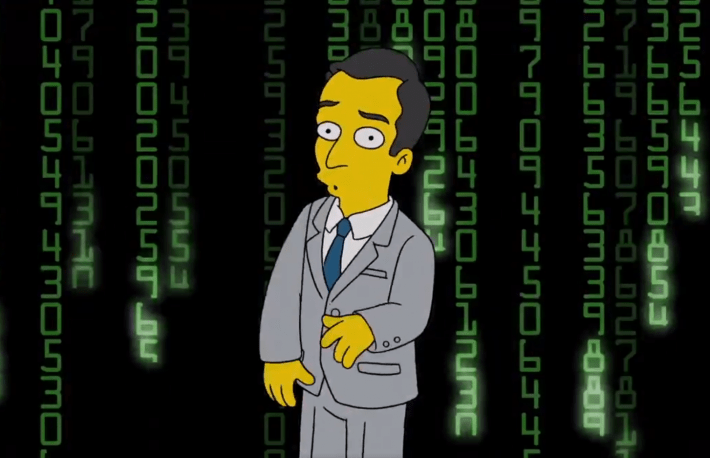
One of the newest episode of “The Simpsons” aired has just featured Jim Parsons of Big Bang Theory as a guest star to explain cryptocurrencies and how a blockchain works.
In the song and dance predicts cryptocurrency to be the future money, the animated ledger states: “Each day I’m closer, to being the cash of the future. Not in your wallet, I’m in your computer!
At the end of Jim’s talk, there is a subliminal message on screen. It further explains how cryptocurrencies work, part of which says:
“Using the word “cryptocurrency” repeatedly while defining cryptocurrency makes it seem like we have a novice’s understanding of cryptocurrency. Well that is a total pile of cryptocurrency. In this system, rules are defined for the creation of additional units of cryptocurrency. They can be generated by fiat like traditional currency or just thrown around randomly or all given to LeBron.”
The crypto community welcomed the episode. Altcoin Daily account has commented:
“The Simpsons did it! Cryptocurrency explained to Lisa by the great Jim Parsons on #TheSimpsons! It’s the money of the future! Bullish!”
Some comments to the tweet also pointed out that the Simpsons has a reputation for predicting the future over the years. Ten years ago it showcased Donald Trump as the president of the U.S., and more recently guessed the Game of Thrones series finale.
A new extortion scam targeting website owners serving banner ads through Google’s AdSense program has begun circulating the Internet. The malevolent scheme demands Bitcoin (BTC) in exchange for preventing an attack, which would purportedly lead to the users’ AdSense account suspension.
The email-based extortion scheme was reported by security news and investigation blog KrebsOnSecurity, on Feb. 17. The blog post detailed that some site owners received a message as their site had been spotted by the malicious program as one seeking revenue from publishing an ad.
Coinbase Pitches Crypto As A Solution For Racial Discrimination
To mark Black History Month, Coinbase has launched an advertising campaign with the pitch that cryptocurrencies can help tackle racial injustice in the financial sector.
As part of the campaign, the exchange published a blog post on Feb. 13 with the results of a survey it conducted in the United States and United Kingdom.
The crux of Coinbase’s survey centers on the notion that blockchain and cryptocurrencies, as trustless technologies with pseudonymous functionality, would be more color-blind than traditional financial services.
Gemcoin Founder Confesses To Fraud
Steve Chen, the mastermind behind the $147 million Gemcoin cryptocurrency scheme, has admitted to wire fraud and tax evasion in a plea agreement.
The 62-year-old Southern California resident agreed that he and other co-conspirators fraudulently promoted a cryptocurrency called Gemcoin (or Gem Coins) that helped fleece $147 million from 70,000 victims.
Chen, also known as “Boss,” reported an income of $138,000 in 2014 which is a far cry from the $4.8 million he now admits to pocketing that year. Chen used the proceeds to buy homes and pay for a gambling habit, authorities said.
Binance Pauses Trading To Fix Technical Issues
Major cryptocurrency exchange Binance halted trading on its platform to resolve an unexpected technical issue with its infrastructure.
An announcement published by Binance on Feb. 19 notes that, due to unscheduled system maintenance, the exchange suspended most of its activities. More precisely, as of press time, it is not possible to perform “deposits, withdrawals, spot trading, margin trading, P2P trading, lending, redemption, as well as asset transfers from sub-accounts, margin accounts, futures accounts, and fiat wallets” on the platform.
In a statement shared with Cointelegraph, Binance reassured its users that partner exchanges such as Binance.US were unaffected and that trading activity will resume shortly.
Major cryptocurrency exchange Binance halted trading on its platform to resolve an unexpected technical issue with its infrastructure.
An announcement published by Binance on Feb. 19 notes that, due to unscheduled system maintenance, the exchange suspended most of its activities. More precisely, as of press time, it is not possible to perform “deposits, withdrawals, spot trading, margin trading, P2P trading, lending, redemption, as well as asset transfers from sub-accounts, margin accounts, futures accounts, and fiat wallets” on the platform.
In a statement shared with Cointelegraph, Binance reassured its users that partner exchanges such as Binance.US were unaffected and that trading activity will resume shortly.
Binance co-founder and CEO Changpeng Zhao explained in a tweet sent earlier today that one of the market data pushers experienced an issue, but the matching engine did not, so no funds or data were lost. He also said in a separate message that futures trading is continuing normally since it employs a separate matching engine.
In an attempt to compensate users for the market disruption, Zhao also promised to waive the trader margin interests for today. In his latest update as of press time, he said that the issues are nearly resolved and that users will have 30 minutes to cancel their orders before normal trading resumes.
This is just the latest issue experienced by Binance users this month. On Feb. 17, Binance released a separate report on performance problems. In the report, the firm admits that it did not anticipate the volume of users who recently started using its platform. The paper reads:
“Last week was a tough one. […] We had a number of performance issues, which negatively impacted the accessibility of our platform.”
Per the report, Binance’s trading platform was unable to manage all users and keep market data, orders and balances up to date. The firm promises to solve these issues soon, and encourages users who were damaged by the performance issues to contact the exchange’s support.
Some Twitter users expressed concern and fear that Binance may have fallen victim to a hack, but there is no evidence suggesting that this is the case. In fact, the performance issues recently reported by the exchange and its users add further credibility to the cause being a simple technical problem.
Steve Chen, the mastermind behind the $147 million Gemcoin cryptocurrency scheme, has admitted to wire fraud and tax evasion in a plea agreement.
The 62-year-old Southern California resident agreed that he and other co-conspirators fraudulently promoted a cryptocurrency called Gemcoin (or Gem Coins) that helped fleece $147 million from 70,000 victims.
Chen, also known as “Boss,” reported an income of $138,000 in 2014 which is a far cry from the $4.8 million he now admits to pocketing that year. Chen used the proceeds to buy homes and pay for a gambling habit, authorities said.
Between July 2013 and September 2015, Chen ran a multi level marketing scheme to promote U.S. Fine Investment Arts, Inc. (USFIA) which rewarded investors first with points, and then with Gemcoins.
These virtual coins were supposedly backed by gems mined by the company and could be traded on the USFIA platform.
While the value of the coins supposedly increased based on the company’s gemstone sales, in reality, the USFIA did not own or operate any gemstone mines. Instead, USFIA bought gemstones from commercial suppliers and assigned grossly inflated prices.
Nick Hanna, US Attorney stated earlier “Mr. Chen’s promises to investors were as worthless as his non-existent mines and phony digital currency. This case should remind all investors that trappings of success may convey legitimacy, but everyone should exercise extreme care when considering giving hard-earned money to any outfit promoting trendy products and extravagant profits.”
Chen has agreed to pay back $1,885,094 in back taxes for 2014 as well as pay a civil fraud penalty and interest.
He’s facing a sentence of 10 years in prison, a fine of at least $500,000, and he’s required to pay “full restitution” to all the victims.
Follow XcelToken Plus to keep up with the current happenings in the crypto world.
Conservative United States think tank the Heritage Foundation argues that instead of launching a central bank digital currency (CBDC), the government should ensure that the public can use the currencies they prefer, including private ones.
In a commentary piece published on Feb. 12, the Heritage Foundation notes that Facebook’s Libra global stablecoin project “is just the latest reminder that providing money does not have to be a centralized function of government.” The report answers to the idea that the public sector must ensure that sovereign currencies stay at the centre of each nation’s financial system.
The report argues that the principle of monetary sovereignty that member of the U.S. Federal Reserve’s Board of Governors Lael Brainard spoke about in February should be replaced with the concept of consumer sovereignty.
The Heritage Foundation cites the popular concerns that stablecoins and cryptocurrencies heighten the risk of crime and fraud, and notes that “the government does not need to create its own digital currency to protect people from these problems.”
The report also cites concerns that the Federal Reserve should not compete with the private sector. The central bank allegedly competes with private banks with its real-time payment tool, which Cointelegraph reported is expected to be a threat to private banks. The paper argues that a CBDC would also be a type of competition detrimental to the private sector.
Per the report, direct government control over every person’s account is part of the goal of such efforts. According to the Heritage Foundation, “this level of government control simply is not compatible with economic and political freedom.”
As Cointelegraph reported earlier this month, Brainard also said during the aforementioned talk that the institution is more open to the idea of central bank digital currency than previously. Yesterday, Congressman Bill Foster questioned a Federal Reserve official on U.S CBDC progress and was told that the institution is not yet sure whether deploying such a digital currency is a good idea.
Ukrainian’s powers stated that crypto mining does not require regulatory activity from governmental oversight bodies or other third-party protocols.
In its legal article on virtual assets published on Feb. 7, the Ministry of Digital Transformation of Ukraine specified that mining does not necessitate directives by state authorities as this activity is measured by the protocol itself and network members.
The agency further added that it will contribute to the development and implementation of decentralized technologies, as well as establish sandboxes for their evaluation and verification, and assessment of potential risks to the market.
The agency swore to promote collaboration between the financial market and virtual assets and their effective development, international best practices on taxation of virtual assets, as well as establish effective mechanisms to prevent abuse and offense from business and law enforcement.
Ukraine has appeared to be actively exploring the digital currency and blockchain space, in recent months. At the end of January, Ukraine’s Finance Minister reportedly said that the State Financial Monitoring Service of Ukraine (SFMS) would be the authority responsible for tracking the sources of origin of the funds on citizens’ crypto wallets. Thus, the SFMS would be able to not only find out the origin of crypto but also detect how those funds have been spent.
Last December, the Ukranian governmentapprovedthe final version of a money laundering law that will handle virtual assets and virtual asset service providers per FATF guidelines.
The new law comprises some guidelines on how the government aims to monitor and regulate the trading of cryptocurrencies. One of the guidelines focuses on individual crypto transactions worth less than 30,000 hryvnia ($1,300), from which the administration will only gather the public key of the sender for the purpose of financial monitoring.
Investment platform CurioInvest and Seychelles-based digital asset platformMERJ Exchange Ltd. will jointly begin offering a token backed by collector luxury cars.
The so-called Car Token (CT1) token is set to be attached to the value of collectible cars giving more people a chance to have a portion of an asset, BNN Bloomberg informed on the 30th of January, 2020.
Bitspark Shuts Down
Hong Kong-based blockchain remittance start-up Bitspark has abruptly announced its closure, citing internal restructuring issues.
On Feb. 3, Bitspark co-founder and CEO George Harrap officially announced the platform’s plans to shut down its services on the 4th of March, 2020.
According to the statement, Bitspark users will be able to withdraw their cryptocurrencies from Feb. 3 to March 4 as the platform’s functionality will stay intact over the period. After March 4, account logins will be disabled for a period of 90 days, with users being able to withdraw their funds via Bitspark customer support.
Crypto Ponzi Scheme Lures Unknown Number Of Baseball Players
Two men charged over an allegedcrypto trading ponzi scheme lured investors, including professional baseball players, with social media posts boasting about their luxurious lifestyles.
On January 30, the Secret Service arrested the Arizona-based founders of Zima Digital Assets, John Michael Caruso, aged 28, and Zachary Salter, aged 27.
Caruso commonly refers to himself as “Krypto King” in social media posts and claims he’s been a cryptocurrency investor since 2012. He has a criminal history and was last released from prison in late 2017.
Cryptojacker Convicted In Japan
A Japanese court has demanded a man who infected website visitors with cryptocurrency mining malware face justice — after acquitting him.
As local daily news outlet The Mainichi reported on Feb. 7, the Tokyo High Court overturned a previous ruling which cleared the man, who was not named, of any wrongdoing.
Justin Sun, Tron Founder, Finally Meets Warren Buffett For Charity Lunch
On Jan. 23, Sun met with Buffett in a private not-for-profit country club in Nebraska, according to a press release shared with Cointelegraph on Feb. 6. The guests also included the founder of Litecoin Foundation, Charlie Lee, the CFO of Huobi, Chris Lee, the head of the Binance Charity Foundation, Helen Hai, and the CEO of eToro, Yoni Assia.
Indian Crypto Community Gets a Excited With The Start Of A New IEO
Source: Google.co.in
Despite regulatory uncertainty and banking restrictions imposed by the Reserve Bank of India, WazirX — the Indian cryptocurrency exchange recently acquired by Binance — launched its WRX coin through an initial exchange offering on Binance Launchpad. On Feb. 5, 2020, WRX coin became available for live trading on Binance. The move was dubbed as a big achievement for the Indian crypto industry, as it will likely lead to global recognition.
Earlier, Cointelegraph reported that the 9,033 winners of WazirX’s token sale on Binance Launchpad were announced. Over 20,000 users participated and more than 136,000 tickets were claimed.






 Future Of Cryptocurrency