9 Amazing Irish Authors That You Should Be Aware Of

From modernist masterpieces to award-winning historical fiction, Irish literature has broken new creative ground again and again. Its breadth defies abbreviation, here is a list of authors that you must read to understand Irish history and culture, before you go on a vacation to Ireland.

Jonathan Swift (1667–1745)

The invention of the relatively young genre of Irish fiction written in English is most often credited to the Trinity College Dublin graduate and cleric Jonathan Swift. Best known for his 1726 satirical novel Gulliver’s Travels, Swift’s writing is said to have influenced everyone from Voltaire to James Joyce. As well as fictional works, Swift also penned several pamphlets championing Irish independence from English rule in his capacity as dean of St Patrick’s Cathedral.

Maria Edgeworth (1768–1849)

Anglo-Irish author Maria Edgeworth was a prolific novelist, known for her astute portraits of domestic life in rural Ireland. Born in England, Edgeworth moved to Ireland as a child with her father, who later homeschooled her in law, politics, literature and other subjects. Her first novel, a realist satire of Anglo-Irish landlords published in 1800, is regarded as the first regional novel. Edgeworth’s work greatly influenced the likes of Sir Walter Scott and Jane Austen.

Oscar Wilde (1854–1900)

Copyrights @ Wikipedia.org

With an insatiable wit that has made him one of the most oft-quoted literary figures in history, Oscar Wilde can sometimes be dismissed with the same snobbishness often applied to comedy generally as an art form. However, the contribution he made to the world of literature during his comparatively short life — particularly through farcically comic plays like The Importance of Being Earnest (1895) — shouldn’t be underestimated, and his only novel, The Picture of Dorian Gray(1890), was one of the first to feature an implicitly homosexual central character.

Lady Sydney Morgan (1781–1859)

Copyrights @ Wikipedia.org

Novelist Lady Sydney Morgan was quite possibly Ireland’s first overtly feminist writer — one of the last projects she worked on, titled Woman and Her Master (1840), examined the mistreatment of women at the hands of men throughout history. A highly successful author making her own money at a time when that kind of independence for a woman went very much against the grain, she made waves in 1806 with the publication of The Wild Irish Girl — an epistolary novel in support of Catholic emancipation. Other works included the 1814 novel O’Donnell, widely considered her best.

WB Yeats (1865–1939)

Symbolist poet WB Yeats was Ireland’s first Nobel Laureate, winning the prize in 1923 — the year after the country gained independence from England — for poetry that was said to “give expression to the spirit of a whole nation”. Considered one of the greatest poets of his time, Yeats also produced many plays throughout his lifetime. Arguably his best and most influential works are those in which he attempted to make sense of the events of the Irish struggle for independence from 1916 onwards, taking place when the writer was in his early 50s.

James Joyce (1882–1941)

Ulysses (1922) author James Joyce once wrote to his brother that, “When you remember that Dublin has been a capital for a thousand years, that it is the ‘second’ city of the British Empire, that it is nearly three times as big as Venice, it seems strange that no artist has given it to the world.” Joyce made it his mission to do just that, writing about his home city even after immigrating to Europe. Becoming a touchstone for Irish literature, Joyce is now regarded as one of the most important writers in history.

Elizabeth Bowen (1899–1973)

Copyrights @ Wikipedia.org

The endlessly prolific Elizabeth Bowen published 10 novels and 13 short-story collections throughout her illustrious career, on top of 16 works of non-fiction. Bowen’s last novel, Eva Trout(1968), won her the James Tait Black Memorial Prize — one of Britain’s oldest literary prizes — and a place on the Man Booker Prize shortlist in 1970, the first year a woman ever took home the prize. Bowen was also the first woman to ever inherit her family’s historic country home of Bowen’s Court in County Cork — she later wrote a book about it.

Samuel Beckett (1906–1989)

Born in Dublin, the avant-garde novelist, playwright and poet Samuel Beckett is often paired with James Joyce as one of the most widely celebrated writers of the 20th century. Another Nobel Laureate, Beckett’s style of modernism did away entirely with convention, and his work had a profound influence on artists of many varieties that followed him, from members of the US’ Beat Generation to classical music composers. He is now remembered with a theatre and drama school in his name at his alma mater, Trinity College.

Seamus Heaney (1939–2013)

Copyrights @ Wikipedia.org

Renowned poet and playwright Seamus Heaney’s 1995 Nobel Prize for Literature is just one of a lengthy list of major accomplishments — including the international Golden Wreath of Poetry, the Commandeur de l’Ordre des Arts et des Lettres and the EM Forster Award from the American Academy of Arts and Letters. A former Harvard University poet in residence, Heaney was called “the greatest poet of our age” during his lifetime, as well as being referred to as “the most important Irish poet since Yeats” by the American poet Robert Lowell.

Use XcelToken Plus on XcelTrip to make your Irish dream vacation possible and make sure to read some of these author’s works before you leave to Ireland to make memories that last a lifetime.

If you enjoy our content join our telegram group- click here

5 Places to Visit in Vík í Mýrdal

Many people when they think of Iceland, automatically think of the capital city Reykjavik. Whilst Reykjavik is an extremely cool place to visit and somewhere you should visit whilst in Iceland, there are so many other amazing places on the island that need to be seen and explored, especially Vík í Mýrdal which is the southernmost sea front village in Iceland.

Copyrigts @ Unsplash.com

There is absolutely no doubt that the Land of Fire and Ice is stunning and people flock to see its natural beauty for themselves throughout the year in their masses. Vík í Mýrdal can certainly hold its own in the breath-taking stakes. Full of natural wonders it certainly is an alluring village and one that cannot be missed when visiting Iceland.

Vík í Mýrdal Church

Copyrigts @ Unsplash.com

Apart from the amazing panorama of the village and beyond, the first thing that pops into sight as you come around the corner into Vík í Mýrdal is the beautiful Reyniskirkja white church up on the hill which was built in 1929. A journey up to it, whether in the car or by foot, is certainly worth it. The building itself is extremely photogenic, as are the views all around it. It is possible to actually get married in this church if you have an Icelandic wedding in mind.

Dyrhólaey

Copyrigts @ Unsplash.com

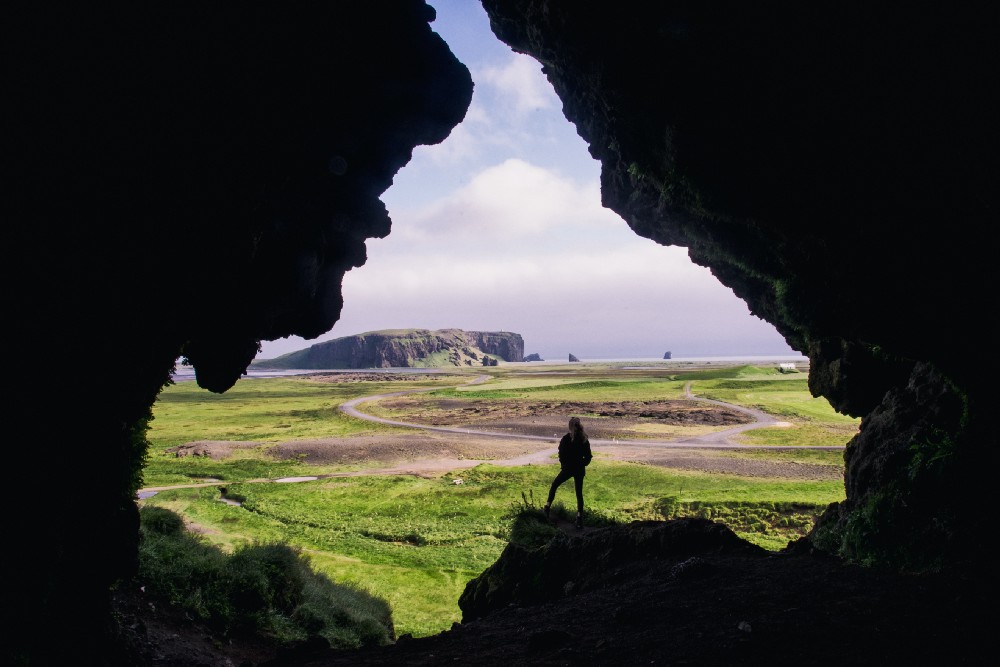
The small peninsula, Dyrhólaey is located just on the edge of Vík í Mýrdal. The name Dyrhólaey means the hill-island with the door-hole which comes from the black arch of lava which stands in the sea in front of the peninsula. The sights which can be seen from Dyrhólaey are stunning, with views of the Mýrdalsjökull glacier, the lava columns of the Reynisdrangar and the south coastline on a clear day. Also, during the summer months, the puffins that can be found on the south coast of Iceland, nest on the cliff faces.

Reynisfjara Black Sand Beach

Copyrigts @ Unsplash.com

Iceland has several volcanic beaches along its coastlines, but Reynisfjara Black Sand Beach is by far the coolest and most famous on the island. It is easily accessible from the main road running through Vík í Mýrdal and taking a walk on the black sand beach is a must. Together With basalt columns, unique lava formations, towering cliffs, and caves the area is a nature lovers delight.

Mýrdalsjökull

Copyrigts @ Unsplash.com

Located just north of Vík í Mýrdal is the Mýrdalsjökull Glacier which stands at 1,493 m (4,898 ft) in height and covers the upper part of Katla, an active volcano which has a history of erupting every 40–80 years. It last erupted in 1918, therefore it is actively being monitored especially after the disruption the Eyjafjallajökull volcano caused when it erupted in April 2010. There are some amazing hiking routes in the area, through breathtaking scenery, so don’t forget your walking boots.

Voyages Friendship Statue

Copyrigts @ Unsplash.com

The statue, standing at 1.8m (6ft), is located on the edge of the Black Sand Beach. It was made by Icelandic sculptor Steinunn Thorarinsdottir who’s inspiration for the aluminium sculpture was the people who make their living at sea and the families who fear they will not return. A second sculpture was given as a gift to the city of Kingston upon Hull, England in 2006 as a token of friendship. Vík í Mýrdal is a picturesque village and this is just a hand full of things that you can see whilst there. It really is a true natural beauty complete with breathtaking and unique scenery. It’s just waiting to be explored when you visit Iceland.

Use XcelToken Plus on XcelTrip to plan your vacation and receive a cool 15% off on all the memories that you are about to make.

Things To Experience in Keflavík

Keflavík is a great place to base yourself when you want to explore the unique Icelandic nature, to enjoy really diverse and impressive views, or to visit the unusual local museums. The Gunnuhver hot spring area,close to the Reykjanes lighthouse, is a very popular place to visit. These otherworldly steamy landscapes will make sure you know you have truly arrived in Iceland, a path will take you safely between the bubbling hot springs and sizzling mud pots, as, in places, soft clouds of steam will surround you. This area is named after a female ghost, who, it is said, caused great disturbance in the area until a priest set a trap for her, and she fell into the hot spring, never to be seen again! Visit the Bridge Between Continents, just off road 425. Standing on the bridge you are above the ravine which formed when the Eurasian and North American tectonic plates moved apart. This bridge has been named Leif the Lucky, after Leifur Eiríksson, known as ‘Leif the Lucky’, he is said to be the first European to have discovered America. You can even get a personalized certificate to commemorate your visit to the bridge from the Reykjanes Information Centre at Duus Museum and Cultural Centre. The Reykjanes area has many areas of exceptional beauty and special geological interest, including the highly active geothermal hot spring area of Eldvörp. A 10 km long row of scoria and spatter cones, formed in the 13th century by the ‘Reykjanes Fires’, are among the more interesting lava features. These cones were formed by volcanic eruptions within the Svartsengi system, this lava covered a massive 20 km2. Within Reykjanes, a total area of 829 km2 has been listed as a UNESCO Global Geopark. As always, when exploring Iceland nature, it is important to keep to the Eldvörp footpaths when you go exploring. Here is a list of activities you can do on your vacation to Keflavik:

Copyrights @ Unsplash.com

Keflavík Hiking

Rifting of the Mid Atlantic Ridge and extensive volcanic activity has given Reykjanes some extraordinarily beautiful scenery. Some very popular and exciting hiking trails follow the coastline and other paths take inland routes. Trekking the trails around Reykjanes would take a few days! A very beautiful short hike from Keflavík will take you to Garðskagi. In the beginning, this follows the old tracks the fisherman used when they walked to their fish drying racks. This trail will take you to the very tip of the headland at Garðskagi, which is renowned for its incredible sunsets. At any time of day, you will get fabulous ocean views, and at nearby Garður, views of two lighthouses. There are numerous seabirds, and seals and dolphins often swim quite close to the shoreline.

Copyrights @ Unsplash.com

Kleifarvatn Lake is the largest lake on the Reykjanes peninsula, situated just 45 minutes’ drive from Keflavík. The lake itself is very beautiful, set in a lunar-like and undulating landscape, topped with small mountains. Stunning hiking paths will take you exploring around the lake.

Keflavík Museums

The culture and ways of the Vikings who settled Iceland are commemorated at the fascinating Viking World Museum. There is a replica of a Viking ship, exhibitions, a café and outdoor exhibits which are particularly popular with children. Duus Museum is the art and cultural center for Reykjanesbær. Art, history and nature exhibitions are held together with various events. There is an Information Center, a café and a footpath to the picturesque cliffs.

Copyrights @ Unsplash.com

The Icelandic Museum of Rock ‘n´Roll at Keflavík attracts many international visitors. In the 1960s and 1970s, this little town gained a big reputation for its musicians, becoming known as bítlabærinn, which means Beatle Town! This area is rich with musical connections, Nanna Bryndis Hilmarsdóttir, the co-lead singer with Monsters and Men, is from the tiny nearby village of Garður.

Location

The town of Keflavík is located just 5.0 km from Keflavík Airport, 48 km from Reykjavík and 18 km from the Blue Lagoon. Nearby places of interest include the fishing village of Grindavík (19 km), Gullfoss (155 km), Þingvellir(86.6 km), Geysir (145 km), and Borgarnes, a town with an interesting history, is 115 km (71.46 mi). Akureyri, the Capital of the North is 429 km (266.57 mi). The distance from Keflavík Airport to Reykjavík is 49 km (30.45 mi).

Use XcelToken Plus on XcelTrip to plan your vacation to Keflavik to make memories that last a lifetime and receive a cool 15% off on all your bookings.

5 Places to Visit in Reykjavík

The capital of Iceland is a young, culturally happening city, as well as a launch pad for natural wonders that people dream of seeing their whole lives. Like any cool spot Reykjavík is also constantly reinventing itself, as you can see at the Grandi Area by the Old Harbour. Here fish packing factories have been turned into sharply designed visitor attractions, while creative murals coat the walls and cutting-edge Nordic restaurants have opened. The waterfront was chosen for the cultural venue, Harpa, a monument for 21st-century Reykjavík with a mesmerising facade by Ólafur Elíasson. You could stay in Reykjavík’s cosy embrace or stride out to visit the volcanic marvels in the Golden Circle and see whales in the Faxa Bay in summer.

Hallgrímskirkja:

Both a parish church and Iceland’s national sanctuary, Hallgrímskirkja is an ever-present feature of Reykjavík’s skyline. Conceived in the early-1940s by Guðjón Samúelsson, the church was 41 years in the making and was finally consecrated in 1986. Flanking the 74.5-metre tower are cascading columns intended to evoke Iceland’s basalt landscapes, all giving the impression of a rocket taking off. Just in front is a statue of Leif Eriksson, the Norse explorer credited as the first European to set foot on American soil at the turn of the 11th century. One of the things to see inside is a colossal 15-metre high and 25-ton organ by the German master Johannes Klais.

National Museum of Iceland:

To get up to speed on Iceland’s 1,200 years of human history there’s only one place to go.

The National Museum of Iceland has a collection assembled since 1863 and moved to its current, rather nondescript building in 1950. This gives no hint of the marvels that are in store inside, laid out over two floors. The most treasured artefact is the Valþjófsstaður door from the early 13th century. The relief in the pine wood echoes the story of Yvain, the Knight of the Lion, a Medieval Arthurian romance. This is one of many fascinating artefacts in the permanent Making of a Nation exhibition, which has over 2,000 objects and 1,000 photographs, beginning with a longboat and ending with a modern airport.

Árbæjarsafn:

Reykjavík wouldn’t be a Nordic capital if it didn’t have a Skansen-style open-air museum shedding light on the customs, work and home life of previous generations. Árbæjarsafn was founded on an abandoned farm in 1957 to preserve a piece of old Reykjavík amid the intense construction taking place in the city at the time. The buildings at the museum are nearly all authentic, dating mostly to the 19th century. There’s a blacksmith’s house, a stable, a labourer’s cottage with an exhibition about life in the Great Depression, a general store, a drill used for gold mining and much more. The museum is open June to August, but has a special Christmas programme in December.

Viðey Island:

In the Kollfjörður almost within touching distance of the city’s waterfront is the small island of Viðey. The Elding ferry service has regular crossings to Viðey, unmissable for its historical architecture and modern culture. You can navigate the island’s trails on foot or by bike, on the hunt for one of the oldest churches in the country, and Viðey House, which was the first structure in Iceland to be built from stone. Against the island’s stark heathland are modern monuments like Yoko Ono’s Imagine Peace Tower light installation. Between October 9 (Lennon’s birthday) to December 8 (anniversary of his death), you can’t help but notice this luminous column from the mainland. From its drum-like stone base the beam rises as high as four kilometres on a clear night. Richard Serra’s environmental artwork, Milestones is on the west side of Viðey, comprising a series of basalt columns alluding to Iceland’s geology and topography.

Street Art:

Cool as ever, Reykjavík has had a dynamic street art scene since at least the 1990s, but over the last few years it has taken on a new dimension. Show-stopping murals now adorn building facades around the Old Harbour and Grandi, the result of a collaboration between the Iceland Airwaves music festival and the Berlin-based Urban Nation art initiative. Titled “Wall Poetry”, these murals are either inspired by individual songs by the likes of Mercury Rev, John Grant or Gus Gus, or are genuine collaborations between the street artist and music artist. They hark back to a now lost time when visual art was integral to albums. Wall Poetry is also just the tip of the iceberg for commissioned street art, in Reykjavík and there are large-scale photorealistic works by Guido Van Helten and fanciful pieces by Sara Riel injecting wonder into the cityscape.

Use XcelToken Plus on XcelTrip to make memories that last a lifetime and get 15% off on all your reservations.

5 Scenic Places to Visit in Iceland

From awe-inspiring glaciers to geothermal springs and active volcanoes, Iceland is a place where nature always takes center stage. Even in the nation’s lively capital of Reykjavik, views of the sea and nearby mountains steal the show. Isolated from the rest of Europe for centuries, this land of fire and ice has a unique cultural heritage of literature, music and cuisine that you’ll find captivating too.

Hornstrandir Nature Reserve

When it comes to viewing Iceland in its natural glory, no region matches the unspoiled wilderness of the Hornstrandir Nature Reserve in Westfjords. While it’s true that its rough terrain of craggy mountains and plunging sea cliffs presents challenges, the Hornstrandir the ideal spot for nature-loving adventurers. With no shops or services within the reserve, however, hikers need to come equipped for any emergency. High on the bucket-list destinations for hiking enthusiasts is the Hornbjarg, a sky-high sea cliff located on the northernmost tip of the reserve. During the summer season, guided tours are available that let you enjoy this top-of-the-world experience in relative safety and ease.

Landmannalaugar

Located within the Fjallaback Nature Reserve in Iceland’s interior highlands, Landmannalaugar is best known for its scenic hiking trails. Situated at the edge of a lava field, the flat and easily traversed region is famous for its natural hot springs as well. Popular treks include short hikes through the lava field and climbs up nearby Mt. Blahnjukur, one of the rhyolite mountains that ridges Landmannalaugar’s graveled plains. Tour companies make regular day trips to the region during the high season, and rudimentary accommodations are available for overnight stays at the site as well

Myvatn

Formed thousands of years ago by a river of hot lava, Myvatn is the best place to visit in Iceland for bird watching. More than 100 species frequent this lake to feast on the midges that give Myvatn its name. Shaped by volcanic eruptions spouting up through the water, the so-called pseudo-craters that dominate the landscape attract visitors as well. The best place to view the craters is on the lake’s south shore near the rural community of Skutustadir. A forest of pillars, caves and rock formations created as the water drained away are on display at Dimmuborgir, the lava fields east of Myvatn.

Reykjavik

Spread out over the Seltjarnarnes peninsula in southwest Iceland, Reykjavik covers a surprisingly large area for a capital with a population of around 120,000. Most visits begin at the visitor’s center located near picturesque Lake Tjornin on the city’s west side. Filled with exhibits recounting Iceland’s Viking heritage, the National and Saga museums are must-see attractions. For a panoramic view of the capital, ride the lift to the observation deck of the modernistic Hallgrimskirkja church east of the lake. With its appealing array of shops, bars and restaurants, the central thoroughfare of Laugavegur is worth exploring too.

Blue Lagoon

Located on the Reykjanes peninsula less than an hour’s drive from Reykjavik, the Blue Lagoon is Iceland’s most popular tourist destination. This man made lake is fed by superheated seawater vented from a nearby lava flow. The geothermal waters contain minerals like silica believed to have health benefits, but it’s the chance to relax in a steaming lagoon surrounded by black lava rocks that most attracts visitors. In addition to a restaurant that overlooks the lagoon, a 35-room resort features an array of pampering amenities, including spa treatments, saunas, steam baths and a fully equipped fitness room.

Use XcelToken Plus on XcelTrip to plan your trip to Iceland and receive a cool 15% off on you all the memories that your planning to make.

6 Delicious Foods to Try in Belgium

Belgium as a country may have been overshadowed by its more popular neighbours but the regional cuisine is enough to entice any serious traveller to this exquisite country. Belgium has been rather famous for its junk food but Belgian food is not just a mixture of mouth-watering dishes or junk food; it is an exquisite blend of food styles of France, Germany, and the Netherlands. The unique food makes it reason enough for anyone, especially diehard foodies, to plan a trip to this heaven of taste buds! After all, Belgium cuisine is made keeping its flavour in mind rather than its look.

Belgian Fries

This is somewhat the national food of Belgium. No one calls it ‘French Fries’ there, even in English. The Belgium-perfected way of fries is a two-step frying process to perfect the inner and outer crunchiness as well as the softness. It is one from the list of Belgium vegetarian food. There is an annual voting of which restaurant or stall makes the best fries. One Belgian food fact is that the fries are a Belgian invention and not French. Although the Belgians have no actual proof they do however make the best fries in the world.

Moules-Frites

Mussels of Mosselen-friet found in the North Sea are more fleshy than those in France and this traditional food in Belgium features mussels cooked either in white wine and classic vegetable broth or in traditional Belgian Beer. It is traditionally served with fries and for many dipping these in the leftover sauce after consuming the mussels is the perfect way to round off this dish.

Stoemp

This creamy dish is the superior version of your regular mashed potatoes and a staple of Belgium food. The belgium traditional food is a creamy blend of mashed potatoes and other vegetables like carrots, kale, brussels sprouts, etc. and served as a side dish or as a main course with sausages.

Grey shrimp Croquettes

This sea-food is also one of the classic Belgium food specialties. It’s a crispy delicacy, usually made from scratch in most seafood restaurants. It’s crispy outside and molten and oozing from the inside. It makes for a perfect snack and is also amongst famous food in Belgium.

Belgian Waffles

Waffles are like Belgium local food. There are two varieties of waffles, the rectangular ones which aren’t as sweet as the other variety but are topped with chocolate, cream, and various grated fruits. The other variant is small and has sugar crystals ingrained, so is more on the sweeter side. This is found almost everywhere, with many places having a unique taste to it. Just avoid extra toppings to get the pure sweet taste of the waffles.

Belgian Chocolates

Talking about sweets, Belgian chocolate can never be left out. Being produced since the 19th century, it is a major part of the economy and Belgian cuisine. Since then, the cuisine has evolved to fit chocolate in many of its desserts such as the pralines, which are soft with a chocolate casing. Truffles are ball-shaped desserts with wafers or cream filled crust. They are available in many places.

Use XcelToken Pluson XcelTrip to go on a food adventure in Belgium and receive a cool 15% off on all your bookings.

5 Amazing Places to Visit in Belgium

Belgium is all about a harmonious fusion of old-world charm and modern culture and trends. From vintage castles, mansions, museums, and churches to modern architecture, shopping arcades and amusements; this European gem is the home of many spectacular places for all types of vacationers. And if you are planning a trip to this mesmeric country, here’s a complete list of places to visit in Belgium. You may get spoiled by choices while going through the list, so it is recommended to pick the places as per the time in hand, vacation itinerary and liking’s.

Brussels

Being the capital city and one of the largest hubs of great museums, palaces, chapels and mansions, Brussels is one of the most popular places to visit in Belgium. This is also the administrative capital of the European Union and pulls tourists from different parts of the World. Famous for world-class cafes, pubs, restaurants and shopping arcades- Brussels offers a plethora of options to make your European holiday enchanting and exciting.

Bruges

One of the most stunning places to visit in Belgium is Bruges- a picturesque medieval town, gifted with historic buildings and canals. The gorgeous palaces, chapels, and mansions of Bruges reflect the history of Vikings while the network of canals, flowing through the city has helped Bruges to earn the title of ‘Venice of the North’. Explore this quaint town in bicycles, enjoy boating in the canal or indulge with Belgian hot chocolate at any of the quaint cafes of the main market square.

Antwerp

A true Belgian delight; Antwerp is all about culture, art, and traditions. On one hand, it showcases vintage architectural wonders and palaces but on the other, there are some modern and trendy art galleries and museums. Known for great food and beer, this place is the diamond district of Belgium as more than 70% of the world’s uncut diamonds are traded here.

Ardennes

Ardennes is a hilly destination and one of the most favorite places in Belgium, among adventure enthusiasts. Ideal for trekking, camping, and biking, Ardennes boasts of thick forests, cliffs, caves and is known for thrilling wildlife like lynx, deer, and wild boar. If adventure is what you are seeking on your trip to Belgium, you won’t be disappointed after your visit to Ardennes.

Mechelen

Located close to Antwerp is Mechelen — another lively and picturesque place in Belgium. Mechelen is unique in many ways. Famous for boat tours and brewery tours; one can climb the massive tower of St. Rombout Cathedral to enjoy the breath-taking view of the Antwerp port or visit the world-famous Carillion School, which is famous for lessons on the complex instrument of bells.

Use XcelToken Plus on XcelTrip to make memories that last a lifetime and receive a cool 15% off on all your bookings.

5 Amazing Cities to Visit in Poland

Life has not been easy for Poland, an eastern European country that has been invaded and destroyed many times over the centuries. The country suffered mightily in World War II when many of its citizens, including its large Jewish population, were hustled off to Nazi concentration camps. The Polish spirit, however, refused to die and today the country combines medieval architecture with lively cultural activities to meet the needs of modern tourists. Here is a list of places that you ought to visit in Poland this autumn.

Krakow

Krakow might be described as a rags to riches city, since it went from being a seventh century village to the second most important city in Poland, being known for its cultural, artistic, academic and economic activities. During World War II, the Nazis herded Jews into the Krakow Ghetto where they were later sent to concentration camps; the movie Schindler’s List centered around one man’s efforts to save the ghetto residents from extermination. Located on the Vistula River, this former Polish capital is easy to get around, since attractions radiate out from Old Town, considered the best Old Town in the country.

Warsaw

The capital of Poland might aptly be compared to a Phoenix rising from the ashes. Founded around the 12th century, Warsaw was pretty much destroyed during World War II, but has rebuilt itself into a thriving historical and cultural center, complete with a restored Old Town. Once known as the “Paris of the North,” it is also famous as the home of classical composer Fryderyk Chopin. Travelers of all ages will enjoy a visit to the Copernicus Science Center where hands-on activities abound.

Gdansk

Also known as Danzig, Gdansk is the largest city in northern Poland and its main seaport since it lies on the Baltic Sea. Founded around the 10th century, it has a mixed political history; at different times it belonged to Germany and Poland, and was a free state before permanently becoming a part of Poland after World War II. The city rebuilt itself after the war, restoring its Old Town, which is famous for the Royal Road that Polish kings traveled on when visiting this historical city. The city is also home to St. Mary church, the largest brick church in the world.

Wroclaw

Located on the Oder River, Wroclaw is the largest city in western Poland. Over the centuries it has been governed by Prussia, Poland, Germany and Bohemia, but has been part of Poland since 1945. The former capital of Silesia is still less well-known as some of the other places to visit in Poland but can definitely compete when it comes to amazing architecture. Main attractions include the market square and the impressive Old Town Hall, St, Elizabeth’s Church with its observation deck overlooking the city, and the largest zoo in Poland. Sailing on the Oder River is a relaxing way to get a feel for this medieval city.

Poznan

Student travelers wanting to meet their Polish peers might want to visit Poznan, long known as an academic center and home to Poland’s third largest university. The city hosts many international events, including the Malta International Theatre Festival that takes place every summer. Major sites are easily accessible by strolling the Royal-Imperial Route, a walk set up especially for tourists. Athletes may enjoy a visit to the artificial lake of Malta, home to a ski slope, ice rink, and swimming pools.

Use XcelToken Plus to book your tickets to Poland on XcelTrip and receive a cool 15% off on all your reservations. 

XcelToken Plus Now on CoinMarketCap

XcelToken Plus with the ticker name XLAB is the upgraded version of XcelToken, which is an ERC20 token on the Ethereum Blockchain Platform, that is painstakingly crafted with the purpose of building, engaging and fostering a large crypto-community within the hospitality, retail and gaming sectors. XcelToken Plus is now listed on CoinMarketCap, a platform that allows you to buy and tracks most of the alternative coins that has hit the market as well as Bitcoins and shows users the current value in dollars and Bitcoins for each coin.

Note- The value of the token in the above picture is from the 30th of September, 2019 at 12:30PM IST. The value will fluctuate based on demand and trading volumes.

On CoinMarketCap you will now be able to trace the prices from whence XcelToken Plus (XLAB) was listed, with values shown in both United States Dollar (USD) and Bitcoin.

XcelToken Plus is a one of a kind utility token, aside from its tradability, is now adopted into usage on platforms such as:

XcelTrip– An online travel booking platform based on the blockchain technology, aims to disrupt the ever-growing trillion-dollar travel industry, through challenging the monopoly of the ecosystem by giving the power back to the users. XcelTrip, allows travellers to check-in at over 1.5 million hotels and book tickets with over 400 airlines. XcelTrip makes sure to give the power of bookings and anonymity to the consumer, since the platform runs on the blockchain system, the consumer is exempt from paying extra credit card charges and other miscellaneous expenditures.

On this decentralised travel platform, aside from XcelToken Plus, crypto-travellers can also use Ethereum, Bitcoin, Dash, Litecoin and Verge currency to book airline tickets and hotels.

Crypto-travellers around the world can either log on to XcelTrip.com or download the XcelTrip app, available on both android and IOS, to book their travels, with amazing cashback offers that run all throughout the year and for those travellers who contribute content and inventory there is a proposition that allows them to earn XcelToken Plus on the XcelTrip platform.

XcelPay Wallet– A merchant POS, digital payment wallet and crypto payment gateway. XcelPay Wallet is integrated into an easy to use, crypto wallet that is enabled for both mobile and tablet use, makes sure that sending and receiving payments in crypto is a secure process.

XcelPay Wallet aims to cut out unwanted middle men, bank/card transaction fees, currency conversion fees that produce a damaging effect on the retailer’s and consumer’s margins, making this a shopaholic’s ultimate companion.

Through XcelPay Wallet, the users can now top up their mobile phone plans with 900 different carrier services and in 160 countries, with Ethereum, Bitcoin and XcelToken Plus.

XcelToken Plus is also a referred token on Bitnare a social media platform that allows for the people of the crypto-community to network with each other within the community on a higher level. XcelGames where the player can collect coins on the game and convert them into XcelToken Plus. The app is available for both IOS and Android devices.

Russian Literary Travel Guide

If you are planning to travel to Russia and are interested in literary history, the places on this list deserve a spot on your itinerary.  Russians are very proud of their rich literary heritage, and this is reflected in their well-curated and oft-frequented museums, houses, and estates dedicated to Russian authors. Here are 5 places we recommend that you visit during your travels to Russia.

Tula – Yasnaya Polyana
Situated outside the city of Tula, about 120 miles south of Moscow, this bucolic estate is where Leo Tolstoy was born and spent most of his life. It features a main house, a school founded by Tolstoy for the peasant children on the estate, and beautiful grounds. The house and school are now a museum, with many of Tolstoy’s books and possessions on display exactly as he left them. Opt for a guided tour, available in Russian, English, French, and German, or just wander the four thousand acres of forests, fields, ponds, and gardens by yourself to take in the atmosphere that inspired War and Peace and Anna Karenina.

Moscow – Bulgakov House, Master and Margarita tour
Mikhail Bulgakov’s The Master and Margarita is one of the most widely-loved novels of the Soviet era. It is set mainly in Moscow, and the Bulgakov museum has created a walking tour of the important places in the story. Travel to Russia and enter Bulgakov’s world and see the locations that inspired him, from his own apartment that became the devil’s hideout to the ritzy Patriarch’s Ponds area where the novel opens. On the night tours you may even encounter some of Bulgakov’s characters in the flesh! The museum is easily accessible by metro, and also holds theatrical productions, art exhibits, a café, and more.

St. Petersburg – Nabokov house-museum
Vladimir Nabokov is most well-known for his novel Lolita. He was also a renowned butterfly collector, who curated Harvard University’s collection of specimens. While he spent most of his life in exile outside of Russia because of political turmoil, the house he was born in in St. Petersburg has been turned into a museum. There you can see his manuscripts as well as his butterfly collection, drawings, and other personal effects. There are also beautiful stained glass windows that Nabokov used as inspiration in many of his works.

St. Petersburg – Dostoevsky house-museum
The apartment in St. Petersburg where Dostoevsky wrote The Brothers Karamazov holds a huge collection of art, photographs, manuscripts, and other memorabilia of the great author’s life and work. The rooms are restored to how they were when Dostoevsky lived here at the end of his life. It is easily accessible by metro, only one block from Vladimirskaya station. The surrounding Vladimirsky neighborhood was his inspiration for the setting of many of his works, and visiting this museum is like stepping into Dostoevsky’s mind. The guided tours insight into the items on display and the stories behind them.

Yalta—Chekhov’s white dacha
In the seacoast town of Yalta on the Crimean Peninsula is a beautiful dacha, or country house, built by Anton Chekhov. He relocated to Yalta because of his tuberculosis (which would eventually kill him, despite the therapeutic sea air) and had this house custom built for him. It was here that he wrote some of his most famous works, including The Three Sisters and The Cherry Orchard. The house is pure white (hence the name) and features expansive gardens. The museum collection includes letters, photos, books, and heirlooms of the Chekhov family.

Use XcelToken Plus on XcelTrip to visit the above places that hold literary significance in Russia.

Book now on XcelTrip with XcelToken Plus to make memories that last a lifetime and receive a cool 15% off on all your reservations.